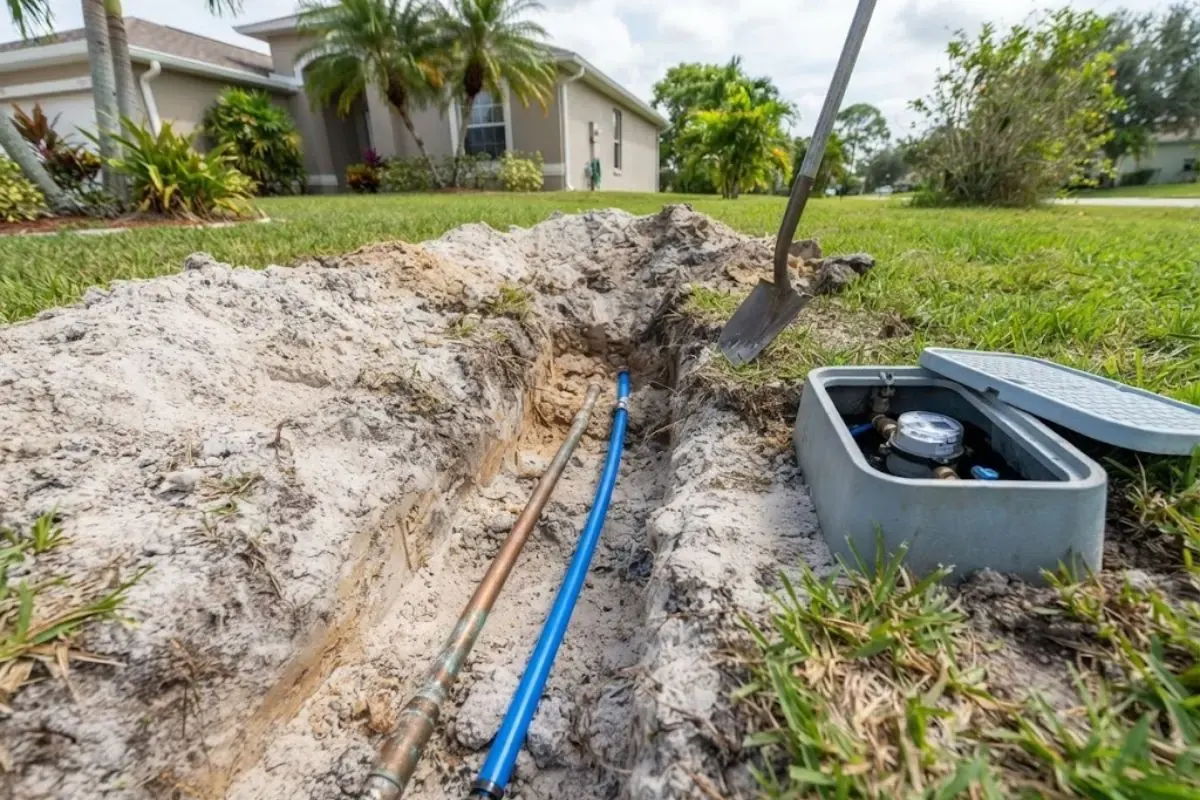
Wet yard, weak pressure, jumping bill, spinning meter
A leaking service line rarely looks dramatic at first. These four signs show up alone or in combination, and each one has a quick check.
| Symptom | What it can mean | First check |
|---|---|---|
| Soggy or unusually green patch of yard | Water seeping up from the buried pipe | Is it wet in dry weather and near the line's path? |
| Pressure drop at every tap | A leak or a restriction upstream of the fixtures | Compare hot and cold, and check a hose bib outside |
| Sudden high water bill | Water is escaping unseen | Compare this bill to the same months last year |
| Meter moves with everything off | A leak on the house side of the meter | Close the home's main valve and watch again |
If the meter stops when the house valve closes, the leak is inside. If it keeps going, the buried line is the suspect.
When a line is gushing, treat it as a flood right now. Close the main, keep away from the wet area near the electrical meter, and call. We aim for same-day appointments when available, and the line is open 24/7.
Where your responsibility starts, and where the utility's ends
Lakewood Water District says the customer's responsibility starts at the customer side of the water meter. Pipes from the meter to the building are the homeowner's to maintain and repair. The shut-off valve at the meter belongs to the utility.
That has a practical effect. If your line breaks, you hire the plumber, and you do not touch the district's valve. The district offers 24-hour emergency shut-off, and emergency shutoffs have no fee, so call them to stop the water at the street while we are on the way.
Check your bill to confirm your provider. Parkland Water District and Summit Water and Supply Company serve parts of the area, so the rules above apply to Lakewood Water District customers, and others should ask their own utility.
Low water pressure: working out whether the line is the problem
Low pressure has many causes, and the service line is only one. Sorting them out takes a few minutes and avoids paying for the wrong repair.
One fixture or all
If only one faucet is weak, the cause is likely a clogged aerator, cartridge or supply stop. If every tap is weak, look upstream.
Hot or cold
Weak hot water only points to the water heater or its valves. Both weak points to the supply side.
Outside bib versus indoors
A strong outdoor spigot with weak indoor taps suggests problems inside the house plumbing.
Gauge test
A pressure gauge on a hose bib shows static pressure. A low reading with the main fully open suggests a leak, a partly closed valve or a restricted line.
Old pipe that has narrowed inside, a failing pressure regulator and a leaking buried line each produce the same weak flow. That is why we measure before we replace anything. If the problem is inside the walls, repiping may enter the conversation.
Finding the line before anyone digs
Digging blind is the expensive way to find a leak. We start by locating the pipe with electronic line tracing, which follows a signal along a metallic line, and acoustic listening, which hears the leak itself. Where the pipe is plastic, a tracer wire or a small device pushed through the line can help.
Before any excavation, buried gas, power and communications lines near the route need to be marked. The plumber should raise that step with you and never dig first.
Repair or replace: a decision table
| Situation | Usual direction | Why |
|---|---|---|
| One leak in a pipe that is otherwise sound | Spot repair | A short section is cut out and replaced, with limited digging |
| Several leaks along the same line | Replace the run | Each patch adds a joint, and the next failure is nearby |
| Pipe that is badly corroded or collapsed | Replace | A repair cannot restore a wall that has worn thin |
| Line is shallow or exposed to freezing | Replace and re-route | The new line goes in at depth, below the 12 inch minimum frost depth in city design criteria |
A plumber confirms the pipe condition after locating and exposing it.
Trenching, trenchless and spot digs
Open trench
A trench exposes the whole pipe, so it lets us see condition, bedding and fittings. It costs the most in lawn, driveway or landscaping restoration. It is often the simplest approach for a short run.
Trenchless options
Trenchless methods pull or push a new pipe through the old path from small pits at each end. They disturb less of the yard, but not every line suits them. A plumber evaluates the pipe, the route and the soil before recommending one.
Spot dig
When we have located a single leak, a small excavation can expose just that section for repair. This is often the first move once the leak is pinpointed.
Permits and who to ask
The City of Lakewood says it is not a full-service permit agency, and sewer, water, electrical and fire-safety permits are handled by outside agencies. The city's building FAQ says a permit is required before installing, altering, repairing or replacing a plumbing system. Confirm with the city permit center whether your repair or replacement needs one.
Anyone doing plumbing work for hire in Washington must be certified by the state Department of Labor and Industries. You can use the state's online verify tool to check any plumber before you hire them.
New lines, relocations and the lead question
Plumbing installation work on the water side includes new service lines for additions, relocated entry points, and new hose bibs or outdoor lines. Our plumbing installation page covers the wider work. The same locating and permit questions apply.
Lakewood Water District advises that homes built before 1985 may have lead pipes or solder. It suggests flushing water that has sat six hours or more, and running 6 to 8 ounces through brass faucets. That does not mean your home has lead. If you are about to open a line, flush before drinking, and ask the district about testing.
Neighbors in Steilacoom buy water from the district, so the same questions may apply there. We dispatch across Pierce County from Lakewood.
What affects the price of a service line repair
You get a clear price before work starts. A line repair varies a great deal, so the factors below explain why.
- Length of pipe involvedA short spot repair costs less than replacing the run from meter to house.
- Depth and soilDeep lines and hard ground take longer to excavate.
- What sits above the lineA lawn is easy to restore. A driveway, patio or tree roots add work.
- MethodOpen trench, trenchless and spot dig each have a different cost and disruption.
- Permits and inspectionIf a permit is required, that step is part of the job.
Insurance usually does not cover the line itself, though some policies offer an add-on for service lines. Ask your insurer before work begins.
Describe the symptoms and we will tell you the price first.
(253) 275-5116Water line questions
Look for a wet or very green strip of lawn, a meter that moves with everything off, a sudden jump in your bill and a pressure drop. Close the home's main valve. If the meter keeps moving, the buried line is the likely culprit.
Lakewood Water District says the customer side begins at the meter. The pipes from the meter to the building are yours to maintain and repair, and the shut-off valve at the meter belongs to the utility.
Yes. We are open 24/7. Close the main, call the district if you need the meter shut off, and call us.
It might be a clogged fixture, a failing regulator, narrowed pipe or a leak. We test pressure at a hose bib, check the regulator and compare hot and cold to find the cause before replacing anything.
Usually not. We locate the leak first, and a spot dig may be enough. Trenchless replacement is another option if the line suits it.
The city's building FAQ says a permit is required for repairing or replacing a plumbing system, but the City of Lakewood is not a full-service permit agency. Confirm with the city permit center.
Flush the lines after work. Lakewood Water District advises that homes built before 1985 may have lead pipes or solder, so flush water that has sat six hours or more.