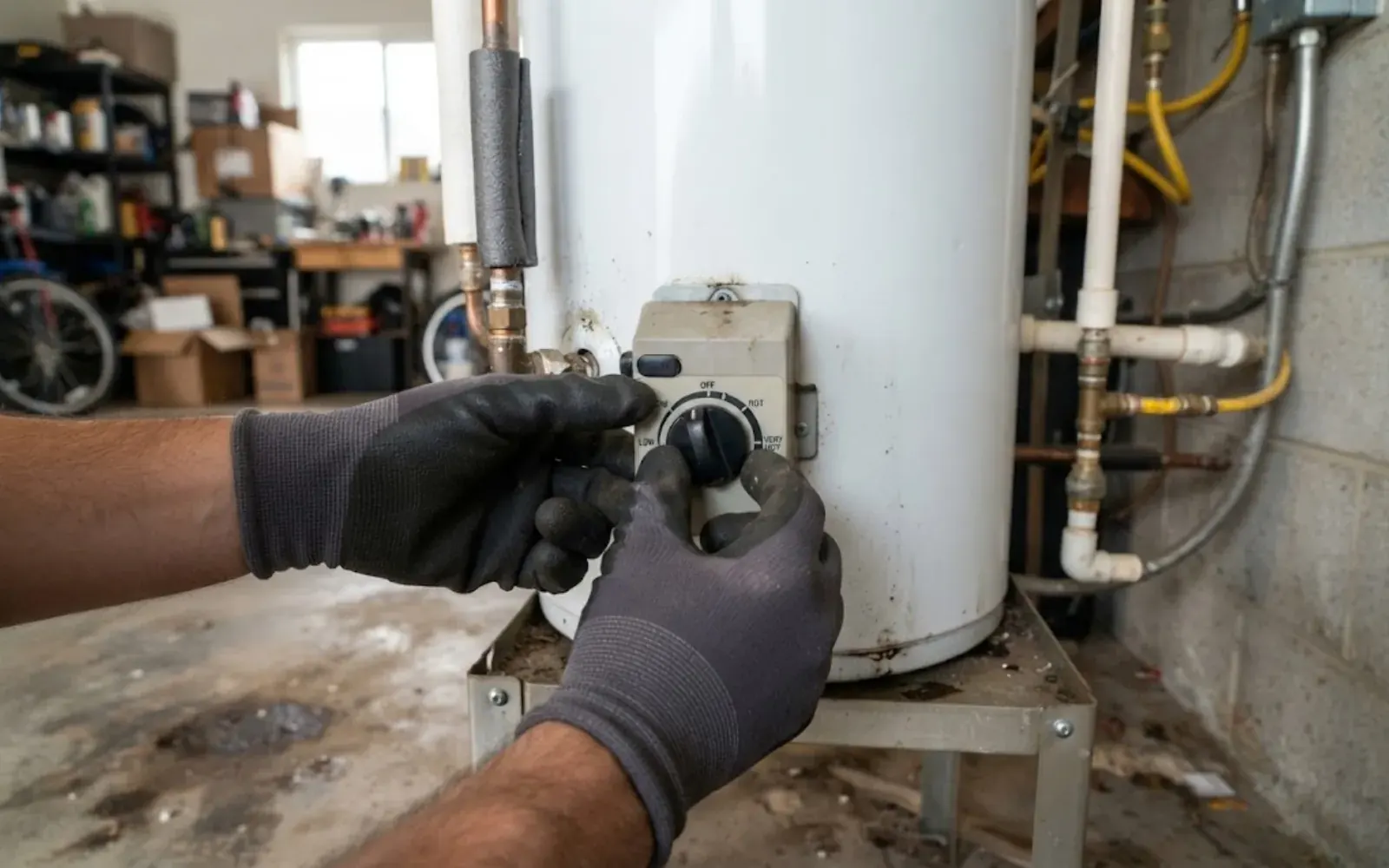
Water around the base of the heater
A puddle under a tank can come from four places, and only some of them mean the tank is finished. Drip stains on the floor tell you less than the source does, so we dry the area and trace where the water starts. Water that runs down the outside of the jacket may come from a fitting above the tank, not from inside it.
A leak from the steel tank itself is different. Water slowly seeps through the shell after years of corrosion, and no part swap fixes it. That is the case where repair stops making sense and we move to a water heater replacement conversation.
Wet fittings on top
Drips at the cold inlet or hot outlet connections often come from a loose union or a worn flex connector. These are repair jobs.
Water from the relief valve pipe
A weeping temperature and pressure valve can mean the valve is worn, or that pressure or temperature inside the tank is running too high.
Drip at the drain valve
The small hose-bib valve near the bottom can seep after it has been opened for flushing. Sometimes it only needs replacing.
Water leaking from under the jacket
Rust streaks near the bottom seam and a wet floor with no wet fittings point to a failed tank shell.
What to do while you wait for the plumber
Safe to do
- Close the cold water supply valve on the pipe above the heater
- Turn the gas control to off, or switch the dedicated breaker off, only if you can reach it without standing in water
- Move boxes, rugs and stored items away from the leak
- Open a hot tap upstairs to relieve pressure after the supply is closed
Do not do
- Touch a tank, cord or breaker while standing in standing water
- Cap or plug the relief valve pipe
- Touch or tighten any gas line or gas fitting
- Relight a pilot that keeps blowing out
If the floor is wet and the heater is electric, shut power off at the panel only when the path to it is dry. When in doubt, stay out of the room and call. We can walk you through the safe shutoffs by phone.
Gas smell: leave first, then call
If you smell gas near a gas heater, do not look for the source. Leave the building right away and call 911 or Puget Sound Energy from outside or a neighbor's home. PSE is the gas provider in Lakewood, and its emergency line is 1-888-225-5773.
Do not use a light switch, phone, garage door opener or any device inside the house, since a spark can ignite gas. We repair the heater after the gas utility has cleared the building. We never advise homeowners to work on a gas line, and we do not ask you to test fittings with soap and water.
No hot water: the quick sort
A tank that has gone cold overnight is one of the most urgent calls we get, especially in a house with children or an older adult. The fault is usually one of a short list, and the type of heater narrows it fast. Our first questions are gas or electric, whether the water is lukewarm or fully cold, and whether any breaker or pilot has changed.
Lukewarm water that runs out quickly points to a failed lower element or a heavy sediment layer. Fully cold water on an electric tank often means a tripped high-limit button or a dead upper element. On a gas tank, a pilot that will not stay lit usually points to a worn thermocouple.
Hybrid, electric and gas heaters fail in different ways
The three tank types share a steel shell and a relief valve. What heats the water, and therefore what breaks, differs. Telling them apart is the first step in a repair, and it decides which parts the technician brings.
| Type | Typical faults | Usual repair |
|---|---|---|
| Gas tank | Pilot out, bad thermocouple, dirty burner, blocked flue, failed gas control valve | Clean or replace the thermocouple, burner or control valve after the gas supply is made safe |
| Electric tank | Burned-out element, failed thermostat, tripped high-limit reset | Replace the element or thermostat, then test the circuit with a meter |
| Hybrid heat pump | Fan or filter blockage, condensate drain clog, sensor or control error, weak compressor | Clean the filter and drain, then check the sensors and control board |
Hybrid units fall back on their electric elements, so a heat pump fault can show up as slow or costly heating instead of cold water.
Electricity in Lakewood comes from Tacoma Power in the north, Lakeview Light & Power in the east and Puget Sound Energy in the west. Which one you pay does not change the repair, but it does matter if you are weighing a switch to a hybrid heater. Check your power bill for your provider.
Part by part: what each failure looks and sounds like
Pilot and thermocouple (gas)
The flame goes out within minutes of lighting, or the heater clicks and never ignites. A thermocouple that no longer senses the flame shuts the gas off by design.
Heating element (electric)
Water starts hot and turns lukewarm fast, or the breaker trips each time the heater runs. Upper and lower elements fail separately.
Thermostat
Water is scalding or only warm no matter where the dial sits. A bad thermostat can also leave an element on too long.
Temperature and pressure valve
It drips, hisses or discharges hot water. Replacing the valve is a standard repair, but a repeat discharge means we look at pressure and temperature, not only the valve.
Anode rod
Rotten-egg smell in hot water or a tank that rumbles can point to a spent anode. Swapping it early can slow corrosion if the shell is still sound.
Sediment
Popping and rumbling noises, and rust-tinted or cloudy hot water, come from scale and grit at the bottom. A flush helps if the drain valve works and the tank is not far gone.
Repair or replace: how we weigh it
| What we find | Usually better | Why |
|---|---|---|
| Bad thermocouple, element or thermostat on a sound tank | Repair | The part is separate and the tank shell has not failed |
| Leaking T&P valve, drain valve or fitting | Repair | The leak is outside the tank |
| Water seeping from the tank body | Replace | A corroded shell cannot be sealed |
| Heavy rust, repeated element failures or a corroded flue | Replace | Repairs stack up while the tank keeps declining |
| Old heater with a single minor fault | Either | Depends on the tank's condition and your plans |
A technician checks the data plate for the manufacture date, which also tells you the tank's age.
We lay out both options and the clear price for each before any parts come off the truck. If a part swap would only buy a few months, we say so. When you decide to replace, our water heater installation page explains what a planned swap involves.
How a repair visit goes
Safe shutoffs first
We confirm the water, power or gas supply is off and that no gas odor is present.
Find the failed part
A multimeter checks elements and thermostats, and a manometer or flame test checks gas burners and pilots.
Price before work
You hear the repair cost and the replacement option side by side.
Test and restore
We refill, purge air, relight or re-energize, and confirm hot water at a fixture.
Not every fix is ours to do. A leak inside a wall or slab, a failed gas line or a tankless fault that needs factory support may need a different specialist. For tankless units, see our tankless water heater page.
What affects the cost of water heater repair
You get a clear price before work starts, after the technician has found the fault. The same complaint can come from a ten-minute part or a failed tank.
- The part that failedA thermocouple or a thermostat is a small job. A gas control valve or a heat pump component is not.
- Heater typeGas, electric and hybrid heaters use different parts and need different test equipment.
- Tank age and conditionRust at the base or a corroded flue can turn a repair into a replacement.
- Access and locationA heater in a tight closet or crawlspace takes longer to service than one in an open garage.
- After-hours dispatchNight and weekend calls are staffed around the clock, and the price is stated before we begin.
Homeowners insurance often covers sudden water damage from a burst tank or line but not the heater itself. Wear and corrosion are usually excluded. Photograph the damage before cleanup and ask your insurer what applies.
Tell us what the heater is doing and we will give you a real price.
(253) 275-5116Rules and credentials that affect a repair
Washington enforces the 2021 Uniform Plumbing Code with state amendments. Two points matter on a repair call: relief valve discharge piping may not have isolation valves, and may not discharge into the heater pan. State code also requires heaters to be strapped against shifting.
The city's building FAQ says a permit is required to install or replace a water heater. Confirm with the city permit center whether a repair part swap needs one. Anyone doing plumbing for hire in Washington must be certified by the state Department of Labor and Industries, and you can check a plumber with the state's online verify tool.
More than half of Lakewood households rent. If you rent, tell your landlord when it is safe to wait. If water is spreading or the heater is gas and something smells wrong, call us directly.
Water heater repair near you
We answer water heater calls across Lakewood in Pierce County, including Tillicum, Oakbrook, Springbrook and the streets near Lakewood Towne Center. Our dispatchers also cover neighbors in University Place and Steilacoom. If you smell sewage along with a wet floor, a drain cleaning call may be the real fix.
What the plumbing code says about relief valves
Washington enforces the Uniform Plumbing Code (UPC), 2021 edition, and that code calls for a temperature and pressure relief valve on a storage water heater. The valve needs a discharge pipe that carries escaping hot water to a safe spot.
If a plumber replaces a worn valve, the discharge pipe stays in place and points downward. Never plug or cap it, because that valve is the last safety device on the tank.
Water heater repair questions from Lakewood homeowners
It depends on where the water starts. Leaks at the fittings, the drain valve or the relief valve are usually repairable. Water seeping from the tank body means the shell has corroded and the heater needs replacing. Close the cold supply valve above the tank and call us so we can find the source.
On an electric heater the usual causes are a tripped high-limit reset, a failed element or a bad thermostat. On a gas heater it is often a pilot that will not stay lit or a worn thermocouple. A heat pump unit may have a clogged filter or a sensor fault. Tell us the type and what you see and we will narrow it down.
Yes. Our line is open 24 hours a day and a dispatcher sends a licensed plumber when a tank is leaking or the house has gone cold. Close the cold supply valve before we arrive. If you smell gas, leave first and call 911 or PSE.
We would rather you did not. If you smell gas, leave the building and call 911 or PSE. With no gas smell, a pilot that keeps going out needs a plumber, since the fault is usually a worn part and not a lighting problem.
A slow drip means something is off, and we do not want you to cap the pipe. The valve may be worn, or pressure or temperature may be too high. Shut the heater off and call us. Never plug the relief valve outlet.
Check the data plate for the manufacture date and look for rust at the base. A tank near the end of its life that develops a second fault is usually a replacement candidate. We give you repair and replacement prices side by side so you can choose.
Yes, for common faults such as filter and condensate drain problems, sensors and element failures. If the unit needs manufacturer support for a sealed system fault, we tell you before we start.