Tankless hot water that runs lukewarm, weak or cold
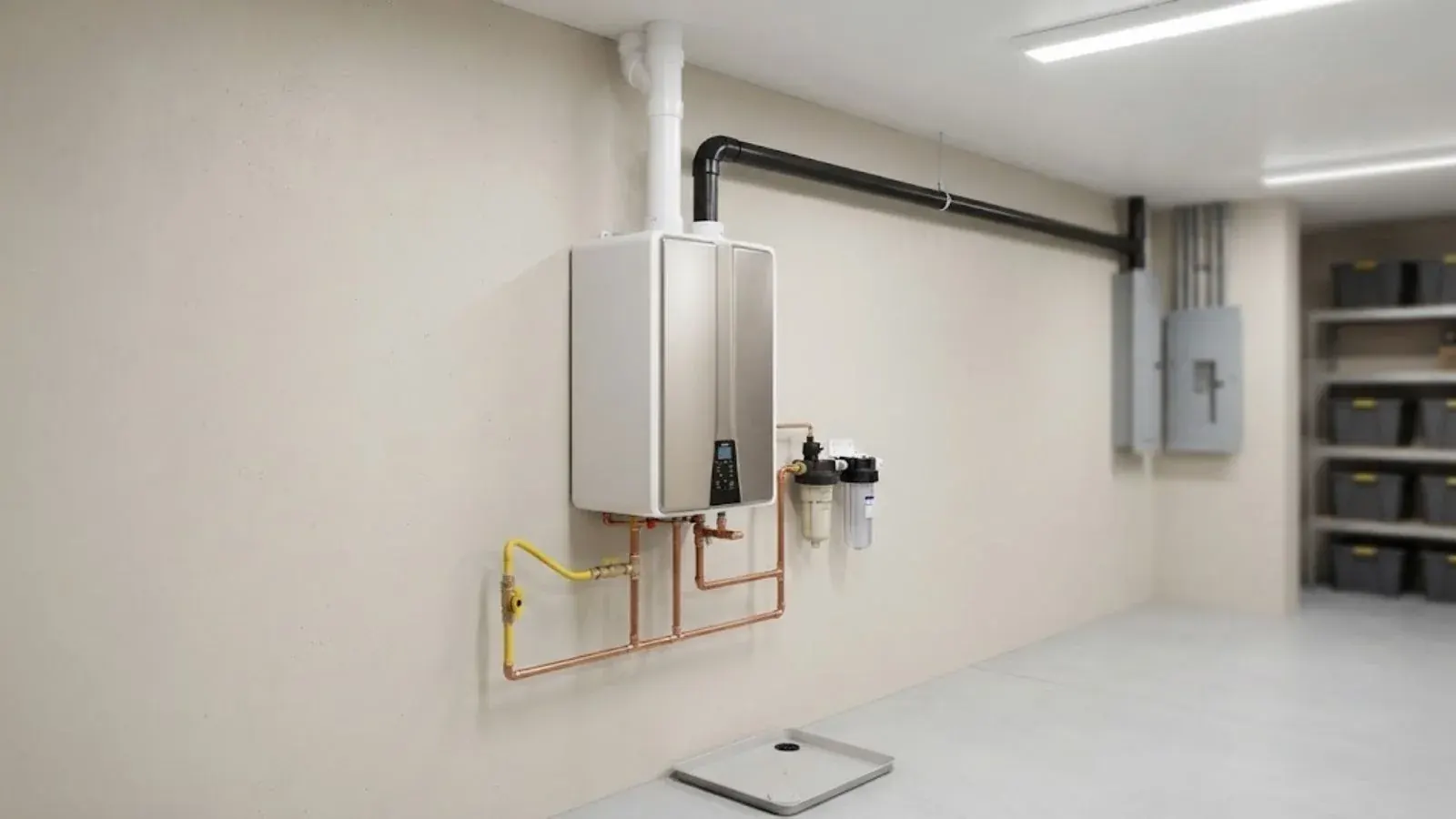
Most tankless complaints start as a symptom, not a part name. The water turns cold for a few seconds in the middle of a shower, pressure on the hot side drops, or the unit shows a code and stops. Each points to a short list of causes.
A cold stretch between two bursts of hot water is the cold-water sandwich. It comes from the unit shutting off and restarting, or from water already in the pipes cooling. Weak hot pressure with normal cold pressure usually points to scale in the heat exchanger or a clogged inlet filter.
Cold-water sandwich
Hot, then cold, then hot again. Short draws can fall below the flow the unit needs to fire.
Low hot water pressure
Cold taps are fine, hot taps are weak. Scale or a clogged filter restricts flow through the unit.
Water never gets hot enough
A failing sensor, a burner issue or heavy scale can limit output.
Error code on the display
Codes point to ignition, flame, exhaust, temperature or flow faults. The manual lists what they mean.
Flushing and descaling a tankless heater
Minerals in water build up on the heat exchanger, and a thin scale layer makes the unit work harder and slows flow. A flush circulates a descaling solution through the unit to dissolve that scale. Many manufacturers call for periodic flushing, and the manual gives the interval.
Most units have two isolation valves on the hot and cold lines and a service port on each. The plumber closes the isolation valves, connects hoses and a small pump, and circulates a descaling solution through the exchanger. The unit is then flushed with clean water and the inlet filter is cleaned.
The solution matters. Some homeowners use white vinegar, but many manufacturers specify an approved descaler or a particular method. Follow the manufacturer's manual, since the wrong product can damage seals. If your heater has no isolation valves, we can add them so future flushes are simple.
We do not state hardness for Lakewood. Test your tap, or ask Lakewood Water District for its annual water quality report if you are a customer. The report did not list a hardness figure, so a test kit is the practical option.
Gas or electric tankless
| Gas tankless | Electric tankless | |
|---|---|---|
| Needs | Gas line sized for the burner, a vent and a condensate drain on some models | Heavy electrical circuit and a panel with spare capacity |
| Strength | High flow for several fixtures | Compact and no vent |
| Watch for | Gas line capacity and vent route | Panel capacity and long wire runs |
The installer checks gas line sizing, venting and electrical capacity. We do not quote numbers for these because they depend on the model.
PSE is the exclusive gas provider in Lakewood. If gas has to be extended or upsized, a utility step may be involved. Electric units work on whichever power provider serves your neighborhood, generally Tacoma Power, Lakeview Light & Power or PSE.
Error codes in general terms
A code is the unit telling you where it stopped. Ignition and flame codes often point to gas supply, a dirty flame sensor or a blocked vent. Exhaust and vent codes point to a blocked or damaged vent. Temperature and flow codes often point to scale, a clogged filter or a sensor issue.
Try the simple things first. Check that the unit has power and that the display shows the code. Do not open the burner compartment or touch a gas fitting. If a code returns after a reset, call us.
Installing a tankless heater
An install changes more than the heater. Gas lines may need upsizing, venting may change and the relief piping needs planning. Washington enforces the 2021 Uniform Plumbing Code, and the city's building FAQ says a permit is required for installing or replacing a water heater. Confirm with the city permit center.
Our water heater installation page covers the permit, venting and licensing points for planned work.
If your tank has already failed, see water heater replacement. If hot water matters tonight, a like-for-like tank is often the quicker route, and the tankless change can wait for a planned visit.
When a tank is the better choice
A tankless unit fits when
- You have the gas capacity or panel space
- Usage is steady and overlapping draws are limited
- You plan to stay long enough to recoup the cost
- You will keep up with flushing
A tank is often the better choice when
- The gas line or panel would need a major upgrade
- You use small amounts of hot water at once
- The vent route is hard to build
- You want the simplest, lowest-upfront option
We say so when a tank fits better. See our water heater repair page if your tank can be saved.
Who should service it
Tankless units combine gas, combustion, electronics and water treatment, so service belongs with a licensed plumber. Some faults need manufacturer support for a sealed or electronic part, and we tell you if that is the case. Check any plumber with the state Labor and Industries online verify tool.
What affects the cost of tankless service
You get a clear price before work starts. The price depends on the job.
- Service typeA flush is a short visit. An install or a major repair is not.
- Isolation valvesWithout service valves, they must be added before a flush.
- Gas and vent workGas line sizing and vent changes add work.
- Electrical capacityElectric units may need panel upgrades by an electrician.
- Unit age and modelParts availability varies.
Insurance does not usually cover maintenance. If water damage occurs, ask your insurer what applies.
Call and describe the symptoms.
(253) 275-5116Venting and gas details follow the manual and the code
A tankless unit must be vented and supplied with gas exactly as the manufacturer's listed installation instructions describe, and the adopted codes back that up. Vent material, length and termination are not places to improvise.
Ask which vent material the plumber plans to use and whether the gas supply was checked against the unit's rated input. We do not install or repair gas lines, and gas work belongs to the right licensed trade.
Tankless water heater questions from Lakewood homeowners
A plumber closes the isolation valves, connects hoses and a pump, and circulates a descaling solution. Follow the manufacturer's manual for the product and interval.
The installer checks gas line sizing, venting and electrical capacity. The city's building FAQ says a permit is required for a water heater, so confirm with the permit center.
That is the cold-water sandwich. It happens when the unit shuts off and restarts, or when water in the pipes cools. Low-flow draws are a common cause.
Scale in the heat exchanger or a clogged inlet filter are common causes. A flush often helps.
It points to an ignition, flame, vent, temperature or flow fault. The manual lists the codes for your model.
Not always. A tank is often the better choice when gas or panel upgrades are costly.
We do not state hardness. Test your tap or ask Lakewood Water District for its annual water quality report.