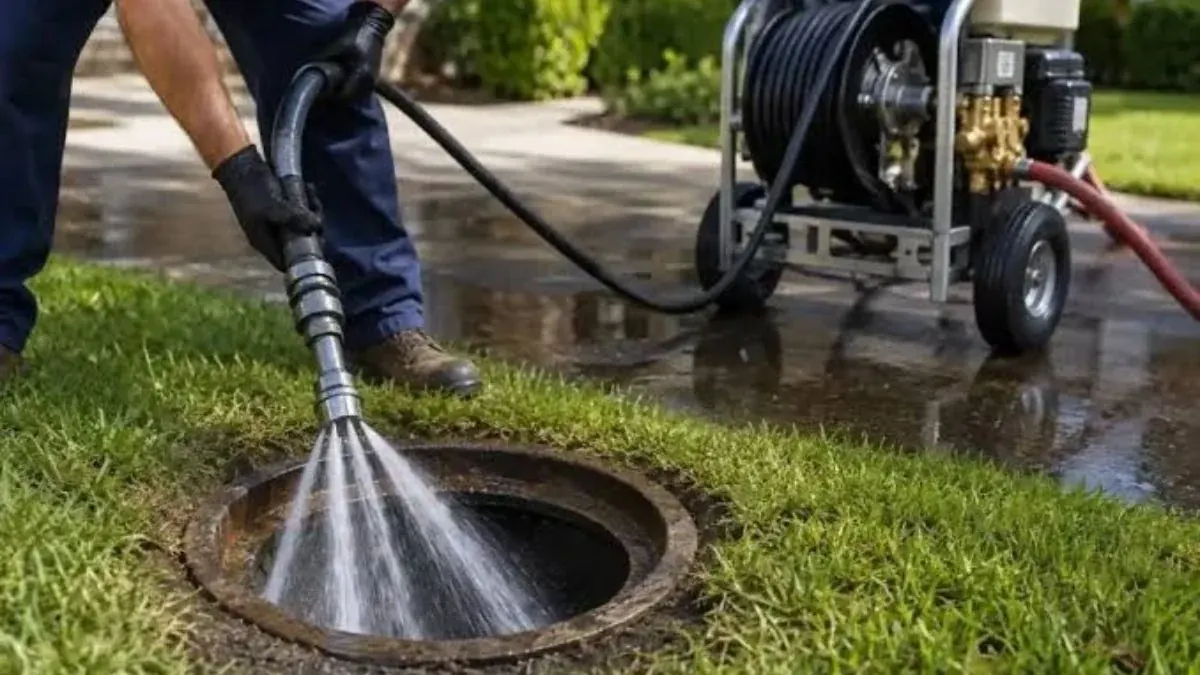
Cable, jetter or root cutter: three tools, three jobs
| Tool | How it works | Good for | Not ideal for |
|---|---|---|---|
| Cable (auger) | A rotating cable head bores through a blockage | Soft clogs, wipes, first-time stoppages | Coated walls and heavy roots |
| Root cutter | A cable with a cutting head, such as chains or blades, trims roots | Woody roots filling the line | Cleaning grease or scale |
| Hydro jetter | Pressurized water scours the pipe wall | Grease, scale, sludge and fine roots | Collapsed or badly cracked pipe |
Many main line calls use two tools in sequence, such as a root cutter followed by a jetter.
We name the tool before we start, and we explain why. A main that clogs once may need only a cable. One that clogs every season usually needs the wall cleaned, which is where hydro jetting comes in.
Backed up tonight: what helps while you wait
A main line backup is a night-and-weekend kind of problem, because the house is in full use in the evening. We dispatch at any hour, and the dispatcher will ask which fixtures are involved. Water in the lowest tub, shower or floor drain usually means the blockage is in the main.
Until the plumber arrives, stop laundry, showers and dishwashers. Flushing once more can overflow a toilet. If you know where your cleanout is, tell the dispatcher, but do not pry the cap off if water is under pressure behind it.
Find your cleanout before the plumber does
A cleanout is a capped pipe that opens straight into the sewer line. It is the best entry point for cabling or jetting. Common places include outdoors near the foundation, in a basement or crawlspace, in a garage, or near the lowest floor drain.
Not every house has an accessible one. Some are buried under soil or covered by landscaping, and some older homes have none at all. When no cleanout exists, the plumber may pull a toilet or work from a roof vent, which takes longer.
If yours is hard to reach, ask about installing one. It turns every future cleaning into a quick job, and a camera pass becomes simple, as our sewer camera inspection page describes.
How often to clean: a decision, not a calendar
We do not hand out a fixed interval, because a line's needs depend on what is happening in it. Use these questions to decide.
- Has the line backed up more than once? Camera it and clean on the footage's advice.
- Are mature trees growing close to the line? Roots may need cutting on a regular basis, and a camera shows how fast they return.
- Is the line shared with a kitchen that sends grease down the drain? Jetting can remove the film that builds up.
- Has the line been clear and quiet for years? A routine cleaning may not be needed.
A recording after cleaning gives you a baseline. Compare it with the next one and the speed of regrowth tells you how often to come back.
Sewer drain cleaning inside the house
A stubborn blockage does not always sit in the yard. A washer standpipe, a basement floor drain or a bathroom group can clog the branch that feeds the main. We clear the branch first, then check whether the main is clean. Our drain cleaning page covers fixture clogs in more detail.
Storm drain cleaning in a wet climate
Lakewood gets about 42 inches of precipitation a year at the nearest NOAA station, so storm drains work hard. Leaves, needles, moss and silt wash into catch basins and downspout lines and settle there. A clogged storm line sends water toward your foundation, driveway or crawlspace instead of away.
The same station records about 21 days a year with lows at or below freezing. Standing water in a partly blocked line can freeze and widen the blockage, so clear a slow line before cold weather.
Public and private storm drains
Storm drains in the street and public catch basins typically belong to the agency that runs the road. Downspout lines, yard drains and catch basins on your property are private. We do not claim the city's rules for who clears what. If the problem is at the curb, call the city or county, and if it is on your lot, we clean it.
- Catch basins fill with leaves and silt and are cleaned by hand or with a vacuum.
- Downspout lines are cabled or jetted from the cleanout or the downspout base.
- Yard drains can be jetted toward the discharge point.
- Never connect a storm line to the sanitary sewer line.
When cleaning is not enough
A line that keeps clogging after proper cleaning may be damaged. A sag, a cracked section or a collapsed pipe will not respond to a cable or jetter for long. In that case the next step is sewer line repair, which we price after the camera shows the problem.
What affects the cost of sewer line cleaning
We give you a clear price before work starts. The tools and time vary with the line, so we price after hearing the symptoms or seeing the access point.
- Tool usedCabling is a smaller job than jetting, and root cutting adds time.
- Length of lineA main to the street takes longer than a short branch.
- Cleanout accessAn open cleanout is quick. No cleanout means more work.
- Camera follow-upA camera pass after cleaning is optional and priced separately.
- Time of dayAfter-hours visits are priced and explained before the truck rolls.
Sewer cleaning is generally maintenance as far as insurance goes. A backup endorsement may cover resulting water damage, so check the policy and photograph the damage.
Tell us what the drains are doing and we will explain the work.
(253) 275-5116Cleaning service near Lakewood
We clean sewer lines in Lakewood and neighboring towns. Homes in DuPont get the same 24/7 dispatch from our Lakewood base, and the same method choices apply.
Sewer line cleaning questions
Common causes are grease buildup, roots entering joints, flushed wipes, and a damaged or sagging pipe. A camera shows which one you have.
Snaking suits a simple blockage. Jetting cleans the whole pipe wall, so it fits recurring clogs. Roots often call for a cutter first.
Yes. A dispatcher answers around the clock and sends a plumber when a main line is backing up. Tell us which drains are involved.
Often outside near the house, or in a basement, garage or crawlspace. It is a capped pipe, usually three or four inches across. If you cannot find one, tell the plumber.
There is no single schedule. Lines with roots, grease or past backups need more attention than a clean line. A camera recording tells you how fast buildup returns.
Yes, on private property. We clear catch basins, yard drains and downspout lines. Public street drains typically belong to the agency that maintains the road.