The drain that keeps clogging after snaking
Plenty of households have paid for a snaking visit, watched the water drain, and then seen the same gurgle return in three weeks. That pattern has a mechanical explanation. A cable head spins through the middle of the pipe and bores a hole through whatever is blocking it.
The grease, scale or root hair stuck to the pipe wall stays where it is. New debris catches on that rough coating, and the opening narrows again. Jetting is the step that removes the coating instead of just punching through it.
Clogs return within weeks
The line opens after a cable pass but slows again quickly. The wall is still coated.
Gurgling after laundry or showers
Air is being pushed through a narrowed pipe. The main line may be partly blocked.
Sewer odor with no visible leak
Sludge and trapped grease give off gas. Cleaning the wall often ends the smell.
Roots returned after cutting
Cut roots regrow from the stub. Jetting flushes the fine hairs a blade leaves behind.
If you are not sure whether your pattern fits, our drain cleaning team can start with a cable and tell you honestly when the result will not last.
Sewage coming up right now: do this while we are on the way
Backups are the reason most people call us for jetting at night. We dispatch for them on weekends and holidays too, and a plumber will confirm on the phone whether the first visit will be a cable, a jetter or a camera.
Do this
- Stop every tap, flush and appliance that drains
- Move rugs, boxes and electronics away from the low drain
- Keep children and pets out of the wet area
Avoid this
- Pouring chemical openers into a full line
- Running the washer to see if it clears
- Touching outlets or cords in standing water
- Walking barefoot through backed-up water
How a jetter works inside the pipe
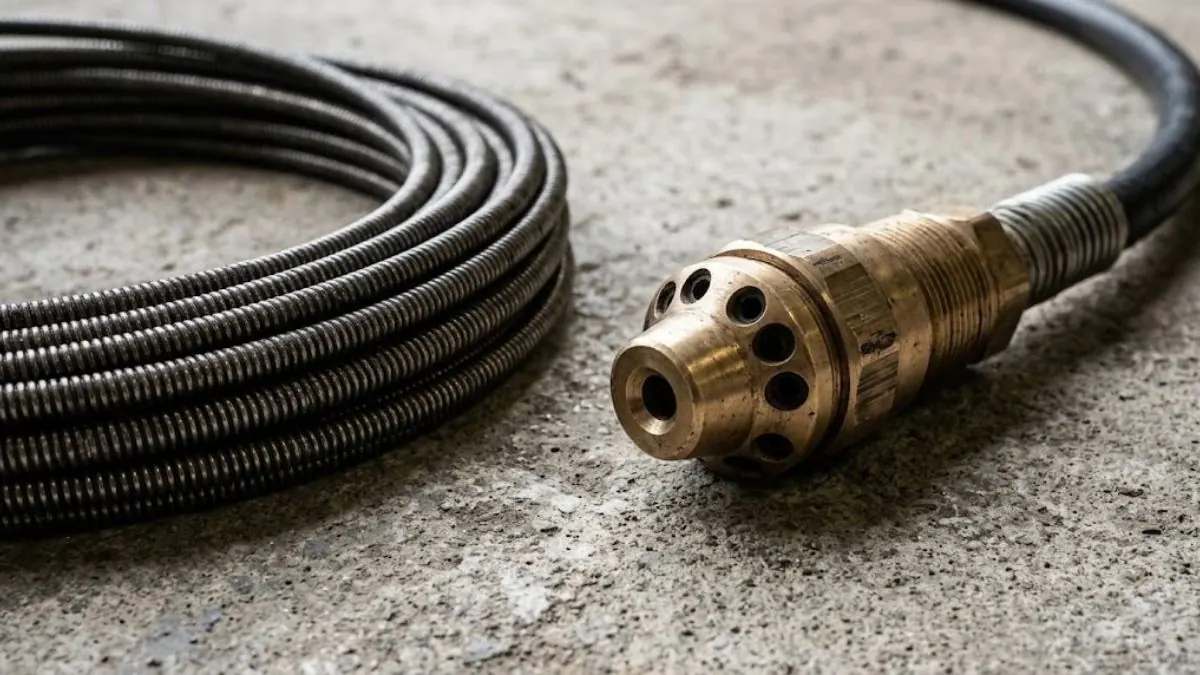
The equipment is simpler than it sounds. A truck-mounted or portable unit pumps water through a reinforced hose, and a nozzle on the end of the hose shoots jets backward and sideways. The backward jets pull the hose forward through the pipe, and the sideways jets scour the wall.
We feed the hose in through a cleanout whenever there is one. At the far end of the clog we pull the hose back slowly, so the nozzle washes the debris toward the opening or downstream to the main.
Access
We find the cleanout or pull a fixture to reach the line.
Run the hose out
The nozzle travels to the blockage and breaks it up.
Wash it back
A slow pull back cleans the wall along the whole run.
Confirm flow
We run water and usually follow with a camera pass.
What jetting clears, and what it cannot
| Blockage | Jetting result | Notes |
|---|---|---|
| Kitchen grease and soap sludge | Strips it off the wall | Often needs warm water in the line afterward |
| Mineral scale and rust flaking | Removes loose layers | Heavy scale may need a descaling head and two passes |
| Fine tree root hairs | Washes them out and cuts small ones | Thick woody roots may need a root cutter first |
| Toys, rags, wipes | Often pushes them through | A stuck object may need to be retrieved |
| Broken or collapsed pipe | Cannot fix it | Pressure can make a weak pipe worse |
| Offset joint or sagging section | Clears debris but not the cause | Repair is the real answer |
Jetting cleans pipe. It does not repair pipe.
When we will not jet: why the camera often goes in first
High-pressure water in a pipe that has collapsed, split lengthwise or separated at a joint can wash soil into the line or open the crack wider. That is why a plumber who has not seen inside the pipe may ask for a camera look before jetting. The footage shows whether the wall is sound enough to take the pressure.
We adjust the pressure and the nozzle for the pipe in front of us. A fragile line gets a gentler head, and a line with a visible break gets repair advice instead of jetting. Our sewer camera inspection page explains what the recording shows and what you get to keep.
If the camera finds a collapsed run or a cracked section, jetting is off the table and the conversation turns to sewer line repair. We will say so plainly and show you the footage.
Older pipe and cast iron: what changes the plan
Lakewood's median home was built in 1974, and about 23 percent of homes predate 1960, according to Census survey figures for 2019 to 2023. We do not know what material your line is made of until we see it, and we will not guess. What age does tell us is that the line has had decades to collect scale and root hairs.
If your drain pipe is cast iron, the inside is often rough and may carry rust nodules and heavy scale. Jetting can clean those lines well, but a corroded wall can be thin in spots. We start at moderate pressure, watch what comes back, and stop if the water carries pieces of pipe wall.
The practical point is simple. Tell the plumber what you know about your pipe, and let the camera confirm it before any pressure goes in.
Jetting or cabling: a decision table
| If this describes your drain | Likely method | Why |
|---|---|---|
| One sink slow, first time | Cable | A simple clog needs a hole, not a scrub |
| Same drain clogged twice this season | Jetter | Wall buildup is probably the cause |
| Kitchen line with heavy cooking grease | Jetter | Water at pressure strips grease a blade smears |
| Main line slow, big trees near the line | Root cutter, then jetter | Cut first, then flush the hairs |
| Water at the cleanout | Cable or jetter after a quick look | Depends on what the first pass finds |
| Known cracked or collapsed pipe | Neither | Repair first |
These are starting points. What the plumber finds on site decides the final choice.
Cabling costs less in labor and equipment, which is why we do not push jetting on a first-time clog. Jetting earns its place when the same line has already been snaked and the problem came back.
What shapes the price of a jetting visit
You get a clear price before work starts, after the plumber has seen the access point and heard the symptoms. Jetting is not one flat job, because lines differ a great deal.
- Length and size of the lineA short kitchen branch is quick. A long main line to the street takes more hose and more time.
- Type of blockageSoft grease washes off in one pass. Hard scale or root mass takes extra passes or a different head.
- AccessAn open cleanout saves time. If we must remove a toilet to reach the line, expect more labor.
- Camera workA before-or-after camera pass is a separate step, and you choose whether to add it.
- Time of dayNight and weekend visits are priced and explained before the truck rolls.
Insurance usually treats a jetting visit as maintenance. Damage from a sudden sewer backup may be covered only if your policy has a backup endorsement, so read yours and photograph any damage before cleanup.
Describe the drain and we will tell you which method fits.
(253) 275-5116Jetting around Lakewood and the neighboring towns
We run jetting calls across Lakewood and over the line into nearby towns. Homes in Steilacoom sit on sloped lots where a line's fall matters, and a jetter flushes debris downhill quickly. Call and we will say what fits your address.
Not sure where the blockage sits? Our sewer line cleaning page covers cabling, root cutting and cleanouts for the main line.
Hydro jetting questions
A cable bores a hole through a clog but leaves grease, scale and root hair on the pipe wall. That coating catches new debris, so the clog returns. Jetting cleans the wall itself, which is why it lasts longer on lines that have already been snaked.
Snaking uses a spinning cable to break through a blockage. Jetting uses high-pressure water from a nozzle that scours the whole inside of the pipe. Snaking suits a first-time clog, and jetting suits recurring ones.
Yes. A dispatcher answers at any hour, and a plumber can come out when sewage is backing up. Tell us which fixtures are affected, and whether water is at the cleanout, so the right equipment is on the truck.
On a sound pipe, jetting at the right pressure is safe. On a cracked, collapsed or badly corroded line, pressure can make things worse. That is why a camera check often comes first and why we adjust pressure to the pipe.
It washes out fine roots and can cut small ones. Thick woody roots usually need a root cutter on a cable first. Roots regrow, so a root-filled line is worth re-checking.
Yes, with care. Rough, rusty walls respond well to cleaning, but thin corroded sections need lower pressure. The plumber will look at what the line is made of and what comes back in the water.
Often yes, by pulling a toilet or working from a roof vent, though it costs more time. Installing a cleanout makes every future cleaning faster, and we can talk through it.