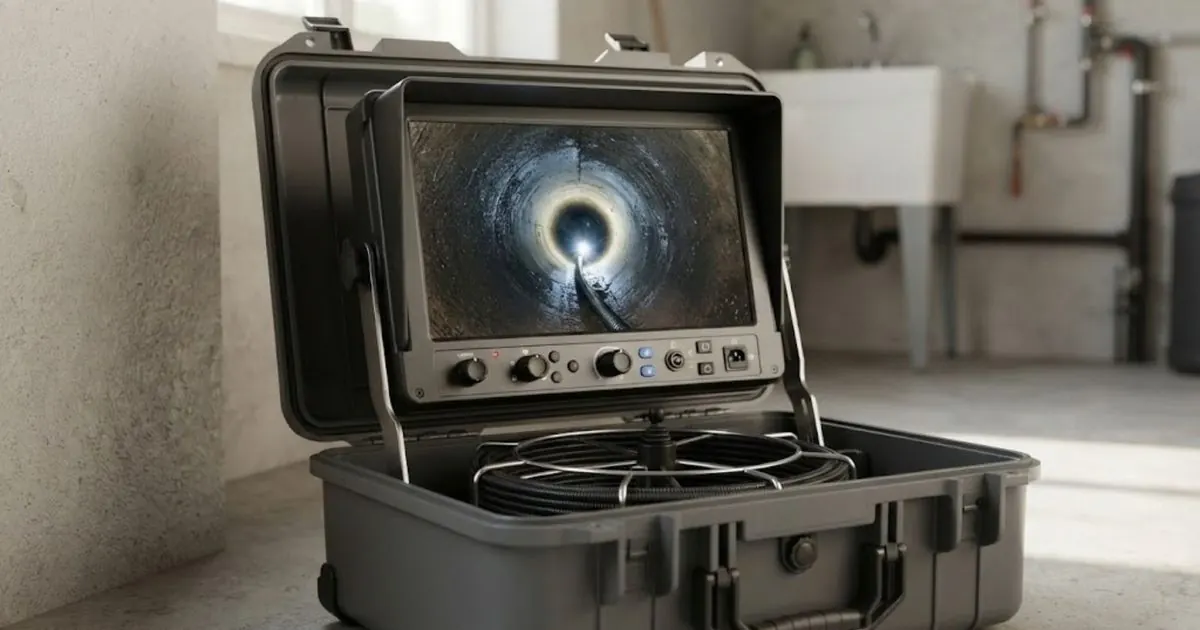
What the camera sees inside the pipe
The camera head is about the size of a small flashlight, with lights around the lens. It travels down the line on a push rod while the plumber watches a monitor. A transmitter in the head can be picked up above ground, which lets the plumber mark where each feature sits.
The picture shows pipe material, wall condition, joints, water level, debris and anything growing into the line. It is the only way to see a problem under a lawn or slab without digging.
Seven decisions a recording can settle
- Is the clog a one-off or a pattern?Footage of the pipe wall shows whether grease, roots or damage keep causing blockages.
- Cleaning or repair?A clear, intact pipe needs cleaning. A cracked or sagging one needs repair.
- Lining or digging?The camera shows whether the pipe is open and straight enough for a liner.
- Where does the line run?A locator marks the path and depth before any digging.
- Whose pipe is it?Footage shows whether trouble is on your side or in the public main.
- Is the line worth buying?A home buyer can weigh a serious defect before closing.
- What has to be fixed first?A list with timestamps lets you put problems in order.
Before you buy: the sewer line is part of the house
A general home inspection does not typically include running a camera through the sewer line. Many buyers only learn about a root-filled or sagging line after moving in. A camera look before closing can show a defect worth far more than the visit, and the recording is useful in negotiation.
About 42 percent of Lakewood housing is in buildings with three or more units, and 55 percent of households rent, per recent Census survey figures. Landlords and property managers also use camera inspections when taking on a building, to see what the line looks like before a tenant reports a backup.
If the recording shows a defect, the next step may be sewer line repair or a cleaning. If the home is on the older side, ask the seller what they know about past backups.
Reading the footage: belly, roots, offsets
A belly
A sag in the pipe where water pools. It shows as a standing puddle on camera and tends to collect solids.
Root intrusion
Fine white hairs or thick tendrils coming through a joint or crack. Roots seek moisture and nutrients inside the line.
Offset joint
Two sections no longer line up, leaving a ledge that catches debris.
Cracks and fractures
Lines or breaks along the wall, sometimes with soil visible behind them.
Scale and grease
Coatings that narrow the pipe and signal a need for cleaning or jetting.
A belly can only be repaired by digging and relaying the pipe at the right slope. Roots and offsets can sometimes be handled with cutting, lining or a spot repair, depending on how bad they are.
When clogs keep coming back
A line that clogs every few months has a reason, and a camera finds it. Wet ground in a climate with about 42 inches of rain a year keeps roots active, so a line near mature trees is a common suspect. If the footage shows only coated walls, hydro jetting is usually the better fix than another cable pass.
What you receive after the inspection
- A walkthrough on siteThe plumber explains what the camera is showing as it travels.
- The footageYou see the recording and what each feature is, so you are not taking a verbal report on faith.
- Marked locationsIf you ask, the plumber paints or flags the line's path and the spots that matter.
- A plain-English summaryFindings are sorted into what can wait and what should not.
If you need the recording for a seller, an insurer or another contractor, ask for it before the plumber leaves.
What a camera cannot do
- It cannot see through a pipe that is completely blocked or collapsed. A line may need clearing first.
- It cannot tell you the age of the pipe, only its material and condition.
- It cannot show a leak that is tight or intermittent. Some leaks need a separate leak detection method, covered by our leak detection service.
- It cannot inspect a line without access. Without a cleanout, the plumber may have to pull a toilet.
- It does not fix anything. Repair, lining or cleaning is a separate step.
Where an inspection leads
Most inspections end in one of three places. The line is fine and you move on with the recording on file. The line is dirty but sound, and the plumber books cleaning, as described on our sewer line cleaning page. The line is damaged, and you decide between lining and digging with the footage in front of you.
What affects the cost of a camera inspection
We give you a clear price before work starts. Inspections are simpler to price than repairs, but a few things still change the job.
- AccessA cleanout makes the job quick. Pulling a toilet adds labor.
- Length of lineA house on a long run to the street takes longer than one near the main.
- Cleaning firstA heavily blocked line may need clearing before the camera can pass.
- LocatingMarking the line's path and depth is a separate step.
- RecordingAsk what format you get the footage in before the visit.
Insurance rarely pays for a planned inspection. If the camera is part of a claim after a backup, your insurer may want the recording, so keep it.
Call to book a camera inspection.
(253) 275-5116Camera inspections near Lakewood
We inspect lines throughout Lakewood and in nearby towns. Buyers in Fircrest should know that some septic remains in parts of that city, so ask whether a house is on sewer before booking.
How inspection findings get graded
Utilities and many contractors grade pipe defects with the coding system from NASSCO, called PACP. A report that names defect types, their position along the line and their severity is far more useful than one that says the line looks bad.
Ask for the footage and the written notes, and ask what each finding means for the next five years. A camera pass proves what is inside the pipe, but only the notes explain what to do about it.
Sewer camera inspection questions
A camera on a flexible rod goes into the line through a cleanout or fixture opening. The plumber watches a monitor, records the run and marks any problems. It is a visual check with no digging.
It is a sensible step. A standard home inspection usually does not cover the sewer line, and defects can be expensive. The recording gives you facts for negotiation.
Yes. The camera head carries a transmitter, and a locator above ground picks it up. That shows the path and depth before any digging.
Ask before the visit. The plumber should show you the footage and explain it, and you can request a copy to keep.
The line may need cleaning first. If the pipe has collapsed, the camera will stop at that point, which is itself useful information.
Usually. A coated pipe needs cleaning. A cracked, sagging or offset pipe needs repair. Our sewer line repair page explains the options.