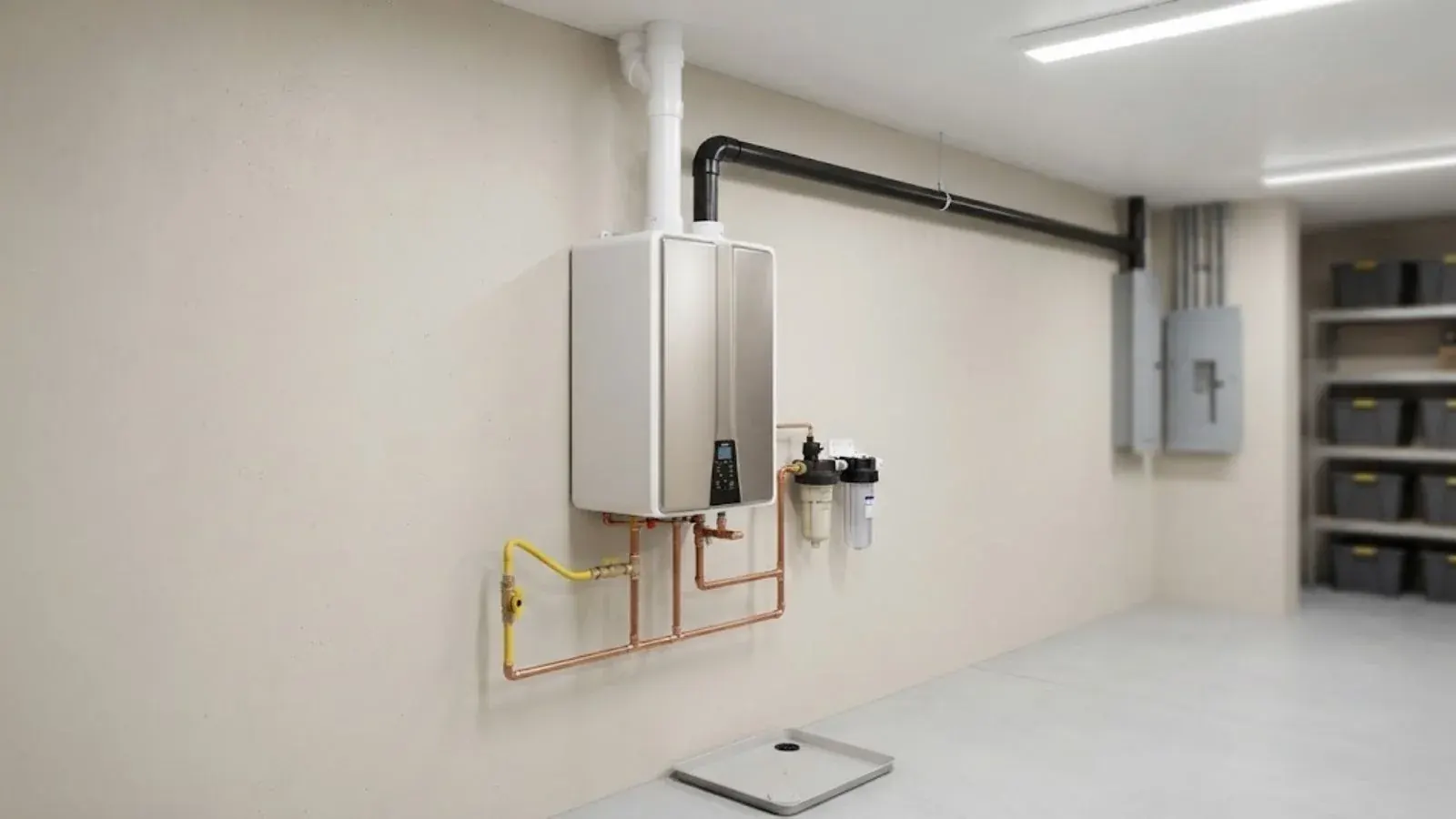
Gas or electric tankless: the real difference
Gas units fire a burner and can raise a high flow of water, so they suit whole-house use. They need a gas line that can deliver the full load, a vent to the outside and a drain for condensate on high-efficiency models.
Electric units use heating elements and need no vent, which makes them simpler to place. Their weakness is the electrical load: a whole-house unit may need very large circuits, and many panels cannot supply that without an upgrade by a licensed electrician.
Smaller point-of-use electric units, which serve a single sink or shower, avoid most of that burden and are a different product from a whole-house heater.
Sizing by flow, not by gallons
Sizing starts with a list of what runs at the same time on a busy morning. A shower, a dishwasher and a bathroom faucet might add up to several gallons per minute. Then comes the temperature rise, which is the gap between the water coming in and the temperature you want out.
Colder incoming water means a bigger rise and less flow from the same unit. A heater that keeps up in August may fall short in January, so size for winter.
- Add up the gallons per minute of every fixture that can run at once.
- Find your coldest-month incoming water temperature with your plumber.
- Compare the total to the unit's rated flow at that temperature rise.
- Round up if two showers and a laundry load overlap in your house.
Tank or tankless: the decision table
| Factor | Tank | Tankless |
|---|---|---|
| Hot water supply | Limited by tank size, then recovery | Continuous, limited by flow rate |
| Space | Floor space and a drain pan | Wall mounted, small |
| Install complexity | Usually a like-for-like swap | Often needs new vent, gas line or circuit |
| Maintenance | Flush the tank, check the anode | Descale the exchanger, clean the inlet screen |
| Upfront price | Lower | Higher, with installation extras |
| Expected life | Shorter | Longer with regular care |
| Best fit | Smaller households, tight budgets, simple swap | Larger households, space-limited homes, long-term plans |
Neither type is better in every house. The right choice follows your layout and your fuel.
Venting, gas lines and drains
Gas tankless heaters move more exhaust through narrower vents than a tank. High-efficiency condensing models vent through plastic pipe and produce acidic condensate that needs a drain. Non-condensing models use stainless vent pipe and run hotter.
The gas line is the item homeowners overlook. A tankless burner can demand much more fuel than the heater it replaces, so the existing line, the meter and the regulator may all be undersized. Sizing is licensed work and your plumber should check it before you order a unit.
If you smell gas at any time, leave and call PSE or 911 from outside before you call a plumber.
What a proper install includes
Load and fuel check
The plumber lists fixtures, confirms gas or electric capacity, and decides whether the line or panel must be upgraded.
Placement and venting
The wall location, vent route, condensate drain and clearance are set before anything is cut.
Connections and isolation valves
Service valves on the hot and cold sides let you flush the unit later without tools or a plumber.
Startup and test
The unit is fired, the flow and temperature are measured, and relief and drain piping are checked.
Our tankless water heater and water heater installation pages explain how that fits with a swap from a tank, and a clear price comes before work starts.
Maintenance you cannot skip
Tankless units need an annual flush to clear mineral scale from the heat exchanger, and the inlet screen needs a look at the same time. Skipped maintenance shows up as lukewarm water, reduced flow and error codes. Heavy scale shortens the life of the heat exchanger.
If you cannot say what the water hardness is, find out. Test the tap with a kit or ask your water utility for its annual report. Harder water means shorter flush intervals.
What drives the price of a tankless install
- Unit capacity and brand, which follow your flow needs.
- Venting length, material and the route through the house.
- Gas line upsizing, or electrical panel and circuit work for an electric unit.
- Condensate drainage and any wall or ceiling finish work.
- Removal and disposal of the old tank, and a permit if one applies.
Because no two houses share the same answers, we price after a look at the space. Insurance does not usually cover a planned upgrade.
Which utility serves your tankless unit in Lakewood
Puget Sound Energy is the exclusive natural gas provider in Lakewood, so a gas tankless unit means PSE is the party you will deal with for meter and service questions. Gas house piping is the plumber's job.
Electricity depends on the neighborhood. Tacoma Power generally serves the north, Lakeview Light & Power the east and Puget Sound Energy the west. If you are considering an electric unit, check your bill to see which utility serves you, and ask that utility about the added load.
The city's older building FAQ says a permit is required for installing or replacing a water heater. Confirm with the city permit center before you schedule the work.
Source type: utility pages and city building FAQ.Tankless installs near Lakewood
We handle tankless work for Lakewood homes and for neighbors in University Place, Steilacoom, DuPont and Fircrest. Have your current heater's location, fuel type and the number of bathrooms ready when you call.
Tankless buying questions
Sometimes, but the vent, gas line and clearances differ. Your plumber checks them before ordering.
Longer than most tanks with regular flushing. Neglect shortens that quickly.
Only if its rated flow at your winter temperature rise covers both. Size for the busiest hour.
It can be, mainly if floor space or fuel is limited. For a simple swap with low use, a tank heater is often the sensible choice.
Most gas units need a small electrical supply for controls and the fan. Confirm the requirement for the model you choose.