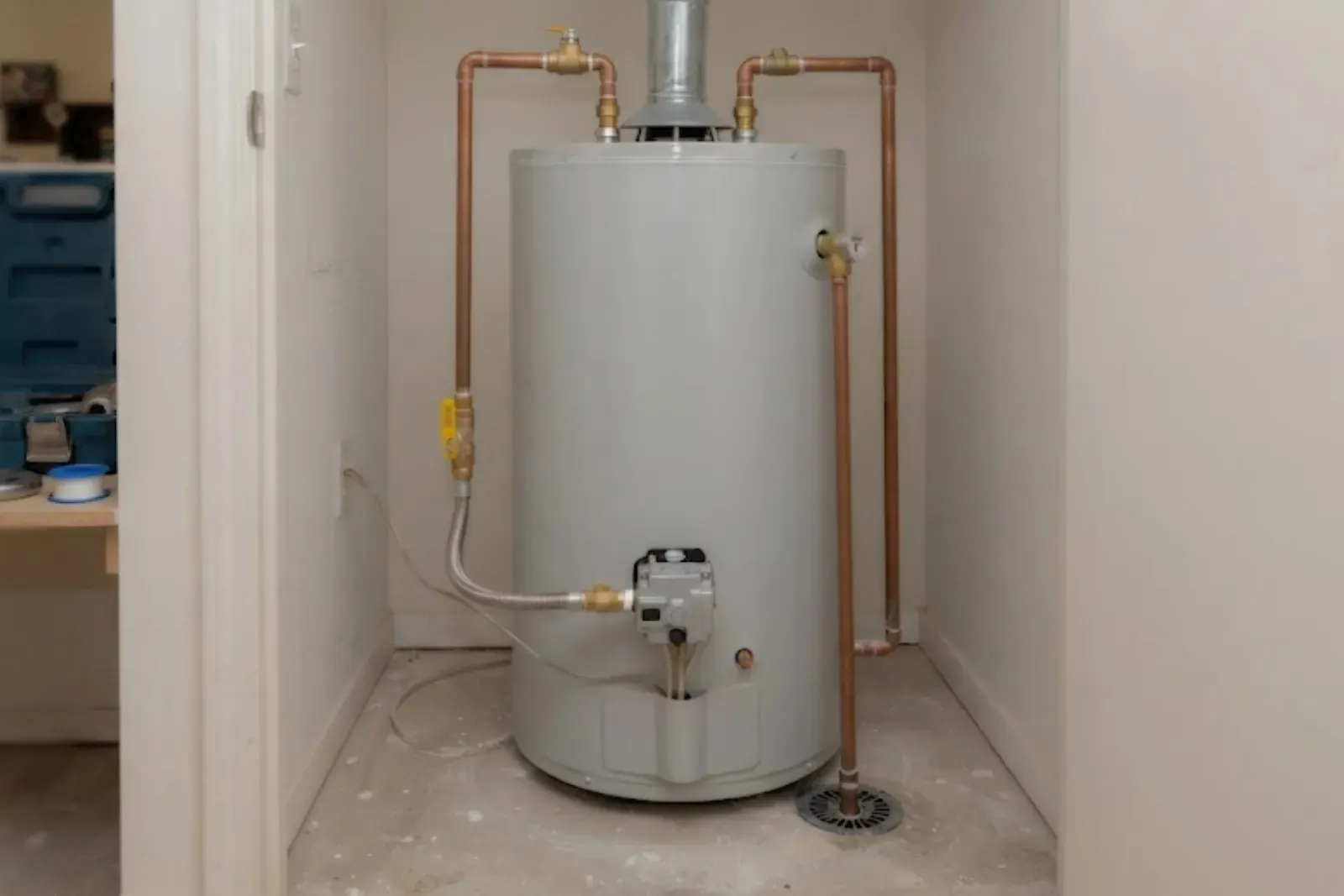
What the manual says and what changes the answer
The manual that came with your heater is the authority on timing. Many list an annual flush, but yours may say otherwise, and a model with a self-cleaning feature may differ.
- Heavier mineral content in your water means more sediment, so flush more often.
- Heavy daily use moves more water through the tank.
- An older tank usually holds more built-up sediment.
- If you've never flushed it, start gently since stuck sediment can clog the drain valve.
What sediment does inside the tank
Sediment forms an insulating layer on the tank floor. On a gas heater, the burner has to push heat through it, which wastes fuel and stresses the steel. On an electric heater, buried lower elements overheat and fail early.
Signs include popping, a rumble as steam bubbles escape, slower recovery and cloudy or gritty hot water. None of these alone proves sediment, but together they point there.
How a flush works
Power down and close the cold valve
Turn off the breaker or set a gas heater to pilot or off per the manual. Close the cold supply valve.
Connect a hose
Attach it to the drain valve and run it to a drain or outdoors, away from people. The water will be hot.
Drain and agitate
Open a hot tap upstairs, open the drain valve and let the tank empty. Briefly opening the cold valve stirs sediment loose.
Refill and restart
Close the drain, refill with a hot tap open until water runs steady, then restore power or gas.
Refilling before power is the rule that saves elements. If you aren't comfortable with gas controls, hand it to a licensed plumber.
The anode rod question
Inside most tanks, a sacrificial anode rod corrodes so the steel doesn't. Flushing is a natural moment to ask whether it's due for a check, since a used-up rod lets the tank itself corrode.
Checking or replacing the rod takes a wrench and often some force. If the rod is stuck or the tank is old, a plumber can judge whether it is worth the effort.
A simple check you can do between flushes
Once or twice a year, run a bucket of water from the drain valve for a minute and look at it. Clear water means little sediment is leaving the tank. Water with grit, flakes or a cloudy tint says sediment is building.
Also look at the tank base and fittings for damp spots or rust trails. Moisture there points to a leak that a flush won't solve. Listen too: a new rumble that wasn't there last season is information.
Write the date of each flush on the tank or in your phone. Over a few years that record shows how fast your own tank collects sediment, which beats any general rule.
When flushing will not help
Flushing may help with
- Popping or rumbling
- Cloudy, gritty hot water
- Slow recovery on a regularly used tank
Flushing will not fix
- A leaking tank or wet floor underneath
- Rusty-brown hot water from corroded steel
- A failed element, thermostat or pilot
- Cold water from a tank that never heats
A tank that is leaking from the body can't be repaired and flushing may stress it. In that case, water heater repair won't be the answer and replacement is likely.
Lakewood water and your tank
Lakewood Water District draws only on groundwater, from four aquifers, and chlorinates all delivered water. Its latest water quality report, covering 2025, lists no violations. Hardness is not stated in the report.
So don't guess at hardness. Test your tap with a home kit or ask the district. Your answer tells you how fast scale is likely to build and whether to flush on the sooner side of the manual's range.
Your provider may not be LWD at all, since Parkland Water District serves parts of the area. Check your bill before you call anyone.
Source type: utility water quality report.What shapes the cost of a service flush
A flush is a small job on a healthy tank, but several things change the quote.
- Tank size and fuelLarger tanks and gas models take more care.
- Sediment conditionA long-neglected tank may need repeated draining.
- Valve conditionA clogged or corroded drain valve may need replacement.
- Anode rod checkInspecting or replacing the rod adds time and parts.
- AccessCramped spots slow everything.
If the flush uncovers a failing tank, we explain next steps before any further work.
Clear price before work starts.
(253) 275-5116Tankless is different
A tankless unit has no tank for sediment to settle in, but scale still builds in its heat exchanger and needs descaling. Our tankless water heater page covers that. We also serve homes in Fircrest and Steilacoom, where the same maintenance questions apply.
Flushing questions
You can try, but go slowly. Long-settled sediment can clog the drain valve, and the valve itself may leak after being opened. If it won't drain, stop and call.
It empties the tank once, then refills it. Most of the volume is the tank itself.
Steam bubbles escaping through sediment cause the sound. Test your tap or ask Lakewood Water District about your water to judge how fast it builds.
The draining is simple but the gas controls are not. Follow the manual closely, and call a licensed plumber if you aren't sure.
It can help by cutting sediment stress, but age and the anode rod matter as well. It isn't a cure for a tank near the end of its life.