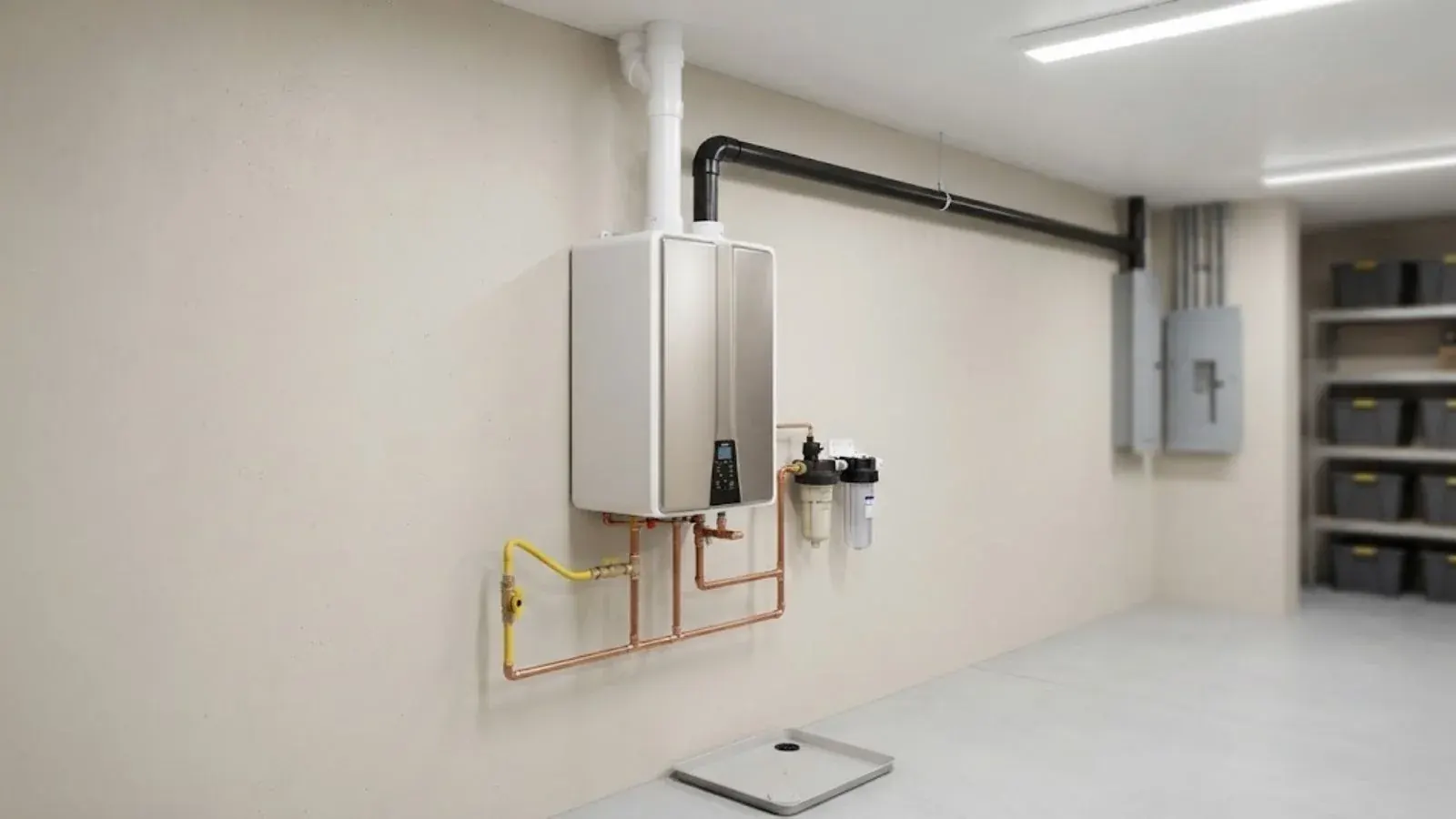
First sort the complaint: weak flow or wrong temperature
Open a cold tap and a hot tap at the same sink and compare them. If cold is also weak, the heater is not the problem, and you are looking at the supply side such as a partly closed valve, a clogged aerator or a pressure issue at the house.
- Compare hot and cold at the same fixture for flow, not temperature.
- Try two or three other fixtures. One weak faucet usually means a clogged aerator, not the heater.
- Check the heater display for an error code and write it down.
- Note whether the problem is worse when a second fixture runs.
Symptom, likely cause, and who handles it
| What you notice | Likely cause | Who handles it |
|---|---|---|
| Only one faucet is weak | Clogged aerator or cartridge | You, or a plumber if the valve is worn |
| Hot flow weak at every tap, cold fine | Clogged inlet screen or scale in the exchanger | Plumber, or you if the manual lists the screen as an owner task |
| Hot, then a cold slug, then hot | Cold-water sandwich from stop-and-start use | Plumber to check settings and any recirculation piping |
| Warm only at low flow, no ignition | Flow below the unit's minimum | Plumber and fixture changes |
| Lukewarm at high flow | Gas supply or unit undersized | Licensed plumber only |
A tankless heater only works as well as the water and gas that reach it.
The cold-water sandwich, in plain terms
A tankless heater has no stored hot water. When you stop the shower and start it again a minute later, the pipe still holds hot water from before, then a short plug of cold water that sat in the heater, then fresh hot water. You feel hot, cold, hot.
The cold slug is partly physics, but a few things make it worse: a long pipe run between the heater and the shower, a unit that needs a few seconds to relight, and a mixing valve set too low. A small buffer tank or a recirculation pump on the right setup can shorten it. Both are changes a plumber should make, not a weekend swap.
Clogged inlet screen and scale
Most tankless units have a small mesh screen on the cold inlet that catches grit before it reaches the heat exchanger. After a plumbing job or a water main flush, that mesh can load up with sediment and cut the flow to the unit by half.
Scale is slower. Mineral deposits coat the exchanger walls, narrow the passages and force the unit to throttle back to protect itself. If your unit has not been flushed since it was installed, it is a prime suspect.
Many manuals call for an annual descaling flush with a pump, hoses and a descaling solution. That is the single best habit for a tankless heater, and our tankless water heater team does it with the right isolation valves so the unit is never run dry.
Minimum flow rate: why a trickle goes cold
Every tankless heater needs a minimum flow before the burner or elements fire, often around half a gallon per minute. A low-flow aerator, a half-open valve or a sink opened just a crack can sit below that line, and the unit never lights.
That is why a tap that is barely running can stay cold while the shower is fine. Open the tap further and the heater should fire. If it only fires at high flow, the flow sensor or a partly blocked screen is worth testing.
When the gas supply cannot keep up
A gas tankless unit can draw far more gas than a tank heater at full firing. If the gas line feeding it was sized for a tank heater and a stove, the burner may be starved when a big demand hits. The result is water that is hot at a low flow and lukewarm when two fixtures run.
Sizing and checking gas piping is licensed work, and nothing about it is a do-it-yourself task. If you smell gas at any time, leave the building and call 911 or PSE from outside, then call us.
Recirculation loops and crossed lines
A recirculation loop keeps hot water moving so fixtures far from the heater get it faster. A bad check valve or a cross-connection at a mixing fixture can send hot water into the cold line, so every cold tap runs lukewarm and the heater fires at odd times.
If the cold faucets feel warm and you hear the heater cycle with nothing running, tell the plumber. It points to a piping fault, not a worn heater.
You can do
- Clean faucet aerators and showerhead screens
- Write down error codes and when they appear
- Check that isolation valves are fully open
- Follow the manual for an owner-level screen cleaning
Leave to a licensed plumber
- Gas line sizing or any gas connection work
- Vent changes or burner concerns
- Descaling flush with the unit open
- Recirculation, check valves and mixing changes
What affects the cost of fixing low hot water
There is no flat answer, because the fix ranges from a ten-minute screen cleaning to a gas line change. The price follows the cause, which is why diagnosis comes first.
- How much sediment or scale is found, and whether the unit needs a full descaling flush.
- Whether a sensor, valve or recirculation part is worn and needs replacing.
- Whether the gas supply must be upgraded, which adds licensed gas piping work.
- Whether the unit is old enough that repair costs approach water heater repair limits and replacement is worth pricing.
We quote a clear price before work starts. Insurance rarely pays for wear and scale, but sudden leak damage may be treated differently.
Water and gas in Lakewood and what they mean for a tankless unit
Lakewood Water District draws all its water from groundwater wells, and all delivered water is chlorinated. Water hardness is not stated in the district's report, so test your tap or ask the district before you decide how often to descale. Heavier mineral content shortens the time between flushes.
Natural gas in Lakewood comes from Puget Sound Energy, which is the exclusive gas provider. If a low-output problem turns out to be a gas supply question, PSE handles the meter and service, while the pipe inside your house is a licensed plumber's job.
Source type: water utility report and gas utility page.Service across the Lakewood area
We service tankless units in Lakewood and send crews to nearby University Place and Fircrest as well. In Steilacoom and DuPont, give us the model number and display code when you call.
Tankless hot water pressure questions
Sinks often run below the minimum flow the heater needs to fire. Open the tap farther or ask about a sink aerator with a higher flow rating.
Yes. The screen sits before the heat exchanger, and a load of sediment can slow the whole unit. Follow your manual, and call us if cleaning it requires more than closing water valves.
The heater does not, but scale and debris inside it restrict flow. Annual flushing keeps the passages open.
It helps when a bathroom is far from the unit. It adds a pump, a dedicated return line or a crossover valve, so talk through the piping with a plumber.
Only if you smell gas, in which case you leave and call 911 or PSE from outside. For weak hot water with no gas smell, call us and we will check whether the line serving the heater is the limit.