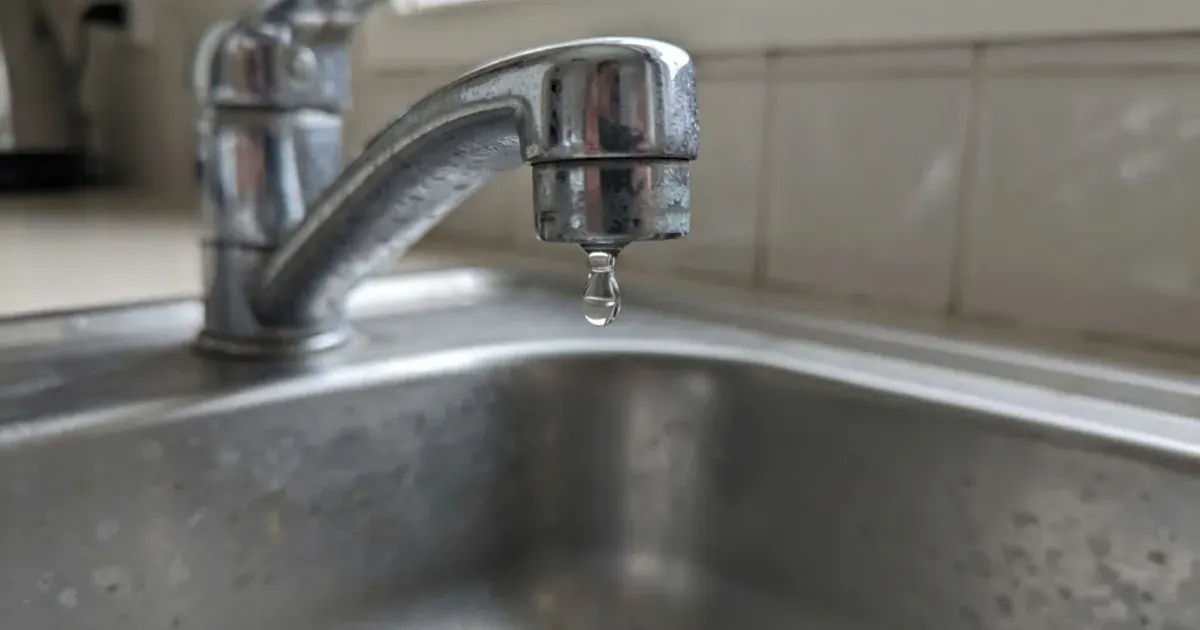
Start here: read the leak
Drip from the spout when off
The cartridge or its seals no longer shut off flow completely. It is the most common single-handle fault.
Water at the base of the spout
Worn O-rings around the spout body let water seep out with every use.
Water under the handle
The cartridge seal or its retaining nut has loosened or worn.
Weak or splitting flow
Mineral grit in the aerator is often the cause, not the faucet itself.
Wet cabinet below
A supply line, a shutoff valve or a failing faucet body. Check the connections with a dry cloth.
Shut off the water before anything else
Look under the sink for two small valves, one for hot and one for cold. Turn each clockwise until it stops. Then open the faucet to drain the lines and confirm the flow has stopped.
If a valve spins freely or will not close, stop there. A stuck shutoff valve is a plumbing job in itself, and forcing it can snap the stem and leave you without a way to stop the water.
Replacing the cartridge
The cartridge is the cylinder inside the faucet body that controls flow and temperature. Over time, its seals harden and the faucet stops shutting off cleanly.
Remove the handle
Pry off the cap, loosen the set screw with a hex key, and lift the handle away.
Pull the cartridge
Remove the retaining nut or clip, note the cartridge orientation, and pull it straight out.
Match the part
Take the old cartridge to a supply store so you buy the exact model and brand.
Reassemble and test
Seat the new cartridge in the same direction, tighten the nut, and open the shutoff valves slowly.
Photograph each step as you go. A cartridge installed rotated the wrong way gives you hot water on the cold side.
O-rings and the aerator
When water gathers at the base of a swivel spout, the O-rings on the spout stem are the usual cause. Lift the spout off, slide the old rings out, and roll fresh ones into the grooves with a thin film of plumber's silicone grease. Match the size exactly, since a ring that is slightly too thick will bind the swing.
For weak flow, unscrew the aerator at the spout tip and rinse out the sand and flakes that collect on the screen. Soaking it in vinegar loosens mineral crusting. If the aerator is clean and flow is still weak, the problem is behind the faucet, in the supply line or shutoff valve.
Repair or replace: a simple test
| Situation | Better choice |
|---|---|
| Drip only, faucet otherwise sound | Replace the cartridge |
| Base leak with a working handle | Replace the O-rings |
| Corroded body or cracked spout | Replace the faucet |
| Repeat repairs within a year | Replace the faucet |
| Parts no longer made for the model | Replace the faucet |
Replacement also makes sense when you are changing the sink or countertop. If the supply lines or shutoff valves are old and stiff, replacing them at the same time costs little extra labor. Our faucet repair page covers what we handle.
Flush after faucet work in older Lakewood homes
The median home in Lakewood was built in 1974, and Lakewood Water District advises that homes built before 1985 may have lead pipes or solder. The district recommends flushing water that has sat for six hours or more, and running 6 to 8 ounces to flush brass faucets.
That matters right after a repair. Opening the plumbing can stir up debris and old solder particles, so run the cold tap for a bit before you drink from it. If you are unsure what your pipes are made of, ask the water district.
Source type: Lakewood Water District customer guidance and Census housing figures.When to call a plumber
- The shutoff valves will not close fully
- Corrosion at the supply line connections
- A leak that continues after a new cartridge
- A faucet mounted on stone where the holes are fixed
- Water damage in the cabinet below
We handle repair and replacement across Lakewood, and our plumbers also dispatch to University Place and Steilacoom. Same-day appointments are available when the schedule allows.
Single-handle faucet questions
The hot side of the cartridge is usually worn first, since heat hardens the rubber seals. A new cartridge for that model normally solves it.
Look for a brand name on the faucet body or under the sink. If there is none, bring the old cartridge to the store and match it by size, stem shape and number of holes.
Run the cold tap for a minute or two first. In homes built before 1985 in the Lakewood Water District area, the district advises flushing, especially after the water has sat.
No. The spout and its O-rings sit directly under pressure, so close the shutoff valves first. If the valves will not close, call a plumber.
Tell the landlord first. If you are the owner, we dispatch to Fircrest daily, and a plumber can repair or replace the faucet in one visit.