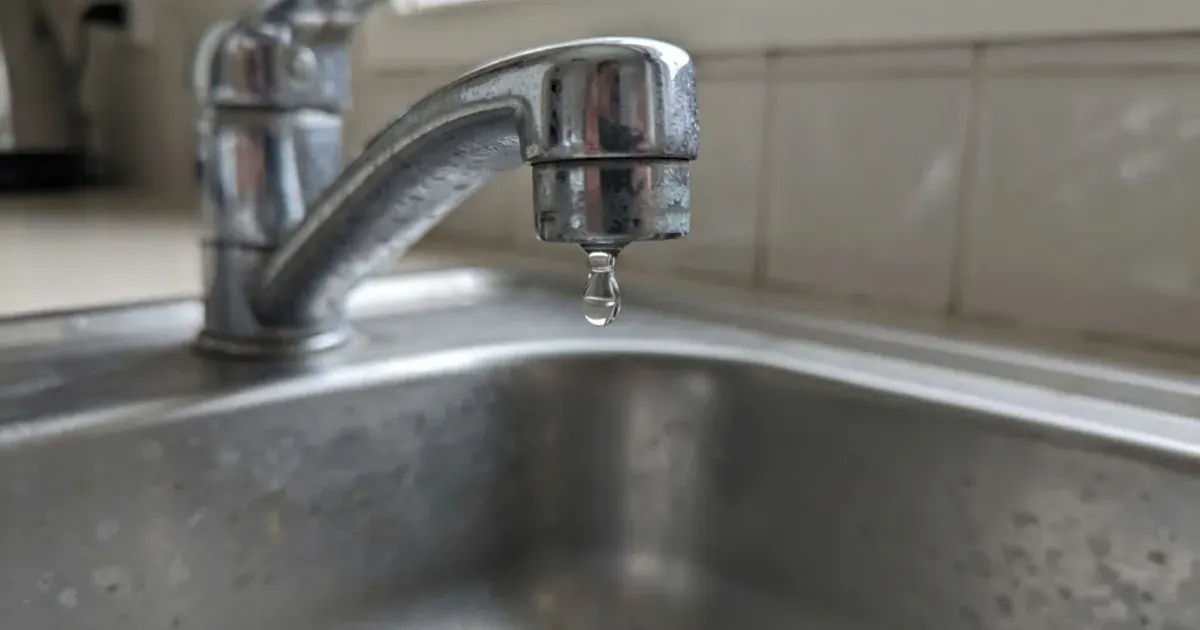
A supply valve or faucet that will not shut off
A broken supply valve usually fails in one of two ways. The handle spins freely without closing the water, or it drips from the stem and will not stop. Either way, the fixture needs a shutoff somewhere else.
Do this while you wait
- Close the main shutoff, usually where the line enters the house
- Open the lowest faucet to drain the pressure
- Set a bucket under any drip and move stored items out of the cabinet
- Turn off power at the breaker if water reaches an outlet or appliance
Please avoid this
- Forcing a corroded valve with a pipe wrench
- Wrapping a leaking stem with tape and leaving it
- Unscrewing a valve that is still under pressure
- Reaching into wet outlets or power strips
The customer side of the water meter belongs to you, and the district's meter shutoff is utility-owned. If the house main will not close either, the Lakewood Water District has a 24-hour emergency shut-off line. Check your bill to confirm that LWD, not another provider, serves your address.
Four faucet designs and how each one fails
| Type | How it works | Typical failure |
|---|---|---|
| Compression | A rubber washer presses onto a seat | Drip from the spout when the washer wears or the seat pits |
| Ball | A slotted ball in the body controls flow | Leak at the base of the handle from worn seals and springs |
| Cartridge | A cylinder slides or turns to mix water | Drip from the spout or stiff handle as the cartridge wears |
| Ceramic disc | Two ceramic plates slide against each other | Seep from the base when sediment scratches a disc |
Single-handle kitchen faucets are usually ball, cartridge or ceramic disc. Two-handle faucets are more often compression or cartridge.
Most repairs are a kit or cartridge, not a new faucet. We match the part to the brand, which is why photographing the faucet and any stamped model number helps if you call before we arrive.
Where the water is escaping
Drip from the spout
Seat, washer or cartridge. Water sneaks past the seal even when the handle is closed.
Water around the handle
A worn packing nut, O-ring or ball seal lets water climb the stem.
Wet base or puddle on the deck
The body gasket or an O-ring around the spout has failed.
Weak flow
Mineral grit clogging the aerator, or a partly closed shutoff below the sink.
The small valves under the sink
Under every sink are two angle stops, the small valves that let you shut off one fixture without touching the rest of the house. They get operated about once a decade, so the stem seal hardens and the valve either drips when moved or refuses to close.
We replace a stop by closing the home's main shutoff, cutting out the old valve and fitting a new quarter-turn type with a braided supply line. Quarter-turn valves stop with a short lever, which is easier on aging hands than a multi-turn knob.
A healthy habit is to turn each stop shut and open once a year, so it does not seize. If one drips even when closed, do not keep tightening it. Call, because a stripped stem can let go suddenly.
Tub spouts, shower valves and showerheads
A tub faucet that runs after the handle is off is the one we hear about most urgently, because the leak is inside the wall. The valve body behind the handle holds a cartridge or stem that wears out, and the water keeps flowing.
A diverter, the lever or pull-up knob that sends water to the shower, can fail too. Water then dribbles from the tub spout during a shower. A showerhead that leaks at the arm usually only needs thread tape and a clean gasket.
If the shower handle drips behind the plate, or the wall around it is stained, stop using the shower and call. A leak behind a tile wall can soak insulation and framing for weeks, and our leak detection service can trace a slow one.
A tub or shower that drains slowly
Hair and soap scum catch on the drain's crossbar and pack into a mat just below. Lift the strainer or stopper and pull the mat out with a plastic drain tool before trying anything chemical. If water still stands, or the sink gurgles when the tub empties, the blockage is in the trap or beyond it, and our drain cleaning team can clear it.
Older homes: lead solder and brass fixtures
The Lakewood Water District advises that homes built before 1985 may have lead pipes or solder. Water that sat in the pipes for six hours or more should be flushed before use, and the district says to run 6 to 8 ounces through brass faucets to flush them.
With a median build year of 1974, that advice applies to many Lakewood homes. After we change a faucet or valve, run the tap for a moment before filling a glass. If a plumbing repair involved the main supply line, repiping is a separate decision covered on our [[repiping]] page.
Repair or replace the faucet?
- Repair when the body is sound and the problem is a seat, O-ring or cartridge.
- Replace when the finish is peeling, the body is cracked or corroded, or parts are no longer made.
- Replace when the sink is being remodeled anyway, since the labor overlaps.
- Replace when two repairs in one year have failed to hold.
Replacing a fixture often costs less in the long run than a third repair. We will say which way the numbers lean once we see the faucet.
What affects faucet and valve repair costs
We give you a clear price before work starts, and we explain what you are paying for.
- Repair kit versus new fixtureSeats and cartridges are cheap parts. A new faucet adds fixture cost and install time.
- Shutoff accessA working angle stop makes the job quick. A seized one means shutting the main and replacing the stop.
- Behind-the-wall valvesTub and shower valves may need an access cut or tile work.
- Brand and availabilityCommon brands have off-the-shelf parts. Specialty fixtures may need ordering.
- Time of dayNight and weekend visits cost more to staff, and the price is told to you first.
Sudden water damage can be covered by homeowners insurance, while a dripping faucet usually is not. Take photos of wet cabinets and floors before cleanup.
Tell us the brand and what is leaking, and we will quote it.
(253) 275-5116Fixture repair beyond Lakewood
We also dispatch for Steilacoom and the surrounding towns. Tell us the faucet brand and age when you call from there, since that decides whether a seat, washer or cartridge kit goes on the truck.
Flow limits and why a new faucet can feel different
Federal standards limit faucet flow, with a maximum of 2.2 gallons per minute at 60 psi, and WaterSense bathroom faucets run at 1.5 gallons per minute or less. A replacement faucet may feel gentler than an older one for that reason.
If flow drops after a repair, a clogged aerator or a partly open stop valve is a likelier cause than the faucet's rating.
Faucet and valve questions
Yes. Dispatch is open 24/7. If a supply valve will not close or a tub faucet will not shut off, close the main shutoff and call. We send a plumber at any hour.
Two handles that squeeze down to stop usually mean compression. A single lever on a round base is often a ball or cartridge. Take a photo and send the make to the plumber when you call so the right kit is on the truck.
The seat it presses onto may be pitted. A new washer cannot seal on a rough seat. We resurface or replace the seat, or swap the faucet if the body is worn.
Yes. Behind the handle the water runs inside the wall, where you cannot see it. Stop using the shower and call as soon as you notice staining, soft drywall or a musty smell.
The work involves shutting off the main and cutting copper or compression fittings. A stuck valve can fail while you work, so call a plumber if it does not turn freely.
Run the tap until it feels cold and clear. In homes built before 1985, the Lakewood Water District suggests flushing brass faucets with 6 to 8 ounces.